
How Dr. Scott Huff helped one patient regain strength, movement and everyday independence
For more than 12 years, one Central Ohio woman lived with persistent throbbing, numbness and tingling in her right arm caused by thoracic outlet syndrome.
The symptoms affected far more than her comfort. Raising her arm for even a few seconds triggered pain and tingling. Simple activities such as washing her hair, buttoning her clothes and throwing a ball with her grandchildren had become difficult or impossible.
After multiple procedures and years of continued symptoms, she was referred to Scott Huff, MD, at Hand & Microsurgery Associates.
The Challenge
The patient was injured at work in 2013 and was diagnosed with thoracic outlet syndrome, a condition in which nerves or blood vessels become compressed in the area between the neck, shoulder and upper chest.
She underwent a first-rib resection in 2014. Although the procedure provided some improvement, she continued experiencing throbbing whenever she raised her arm overhead.
In 2021, she underwent another procedure intended to release the pectoralis minor tendon and create more room for the nerves and blood vessels supplying her arm. Unfortunately, her symptoms continued.
A dynamic ultrasound later revealed that the pectoralis minor had only been partially released. After additional evaluation confirmed that the compression remained, she was referred to Dr. Huff.
Dr. Huff’s Evaluation
During his examination, Dr. Huff found symptoms consistent with retropectoral thoracic outlet syndrome. When the patient’s arm was raised and rotated, pain and tingling began within approximately 10 seconds.
Her physical examination, lengthy history and ultrasound findings all pointed to continued compression beneath the pectoralis minor.
Because the original release had not been completed, Dr. Huff recommended an arthroscopic pectoralis minor release.
Photo 1 – Arthroscopic View
This is an inside view of the shoulder showing the area where Dr. Huff discovered that part of the pectoralis minor tendon was still attached following the patient’s previous surgery.
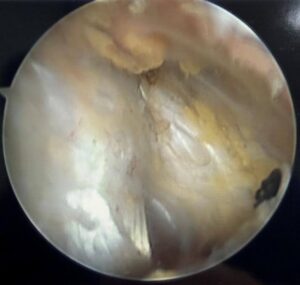
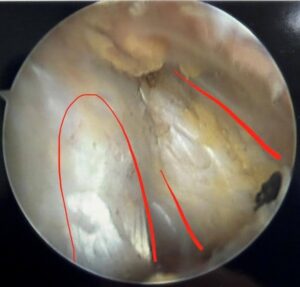
Photo 2 – Marked Arthroscopic View
The marked image helps identify the anatomy. The red outline on the left highlights the conjoint tendon, while the two red lines on the right show the edges of the remaining pectoralis minor tendon that had not been fully released during the earlier surgery.
A Minimally Invasive Approach
Rather than performing another traditional open procedure, Dr. Huff used several small incisions and a camera to carefully examine the structures surrounding the shoulder’s coracoid process.
The camera allowed him to work within a very small space and confirm that a substantial portion of the pectoralis minor tendon and muscle remained attached. He was then able to complete the release and visually confirm that the tendon had moved away from the underlying nerves and blood vessels.
This specialized arthroscopic approach is not commonly performed, but it allowed Dr. Huff to address the remaining compression with smaller incisions and direct visualization of the affected anatomy.
The Outcome
The patient experienced relief from the numbness and throbbing almost immediately following surgery.
Rehabilitation remained important for rebuilding strength and improving her range of motion, but the symptoms that had limited her for more than a decade were finally relieved.
Today, she reports better range of motion, increasing strength and no continued throbbing. Most importantly, she can once again perform everyday activities that many people take for granted.
For the first time in years, she was able to wash her hair without lowering her arm every few seconds because of pain.
In the Patient’s Words
“I only wish I had met Dr. Scott Huff earlier. I wouldn’t have missed out on all those years of not being able to throw a ball with my grandchildren or use my arm at full capacity.”
“My range of motion continues to get better, and I’m continuing to increase my strength without throbbing. I’m able to wash my hair without having to put my arm down every seven to ten seconds.”
“My surgery was a complete success. I don’t have any throbbing anymore. Dr. Scott Huff fixed me!”
Dr. Huff’s Perspective
“This patient had experienced symptoms for more than 10 years and had both imaging and physical-examination findings consistent with continued thoracic outlet syndrome caused by compression beneath the pectoralis minor.
“Using an arthroscopic approach, I was able to confirm that a substantial portion of the tendon and muscle remained attached, complete the release and free the underlying neurovascular structures.
“Her compressive symptoms improved essentially immediately after surgery. Hearing that she could wash her hair without repeatedly lowering her arm for the first time in nearly a decade was an incredibly meaningful measure of her recovery.”
Specialized Care That Changes Everyday Life
Successful treatment is not measured only by what happens in the operating room. It is measured by what patients can return to doing afterward.
For this patient, success meant raising her arm without throbbing, washing her hair without stopping and rebuilding the strength to enjoy time with her grandchildren.
After more than a decade of discomfort and limitations, specialized evaluation, arthroscopic surgery and dedicated therapy helped her regain movement—and an important part of her everyday life.
Individual outcomes vary. This story is shared with the patient’s permission and is not intended to guarantee results or replace an individual medical evaluation.